Nedbank LVCC Calendar

Showing posts with label preparation. Show all posts

Thursday, 29 May 2014

2014 Comrades Marathon Countdown Pt 16

The wrap.

Here's hoping you all have a great run, and safe journey to KZN and home again.

Remember a few things that can make or break your day:

  • Stay healthy. Keep away from people with any sign of illness. Chances are you won't get anything between now and Sunday, but for the sake of your mind, keep clean.
  • Eat well, but carefully. Don't eat anything that you wouldn't normally eat. Avoid rich foods, and all those spicy foods in Durbs (and all)
  • Be cautious on carbs. No, I don't want to start a debate on this. Leave the debate between Tim Noakes vs the rest of the nation. But overdosing on carbs will make you feel sluggish, heavy and bloated - a feeling you will only be able to get rid of behind a bush somewhere near Drummond. By cutting down on your running in this last week, you are not burning as much, so your body will be storing glycogen anyway. By all means take in some extra carbs in the last 2-3 days, but don't over do it.
  • Drink lots. Energy drinks, carbo loading and any other supplements that you may be popping (even the good ol' vitamin supplements) do put an extra strain on your body, especially your kidneys. Long distance running further adds to the strain on your kidneys. Drink plenty extra water now, and keep it up until Tuesday next week.
  • You might be running for charity, family or friends. Don't forget that you are also running for yourself.
  • Remember what your mother taught you - don't run with scissors.
Have a great run! Looking forward to seeing some of you on TV!


Cheers,
Andrew.


Pain is temporary - internet results last forever!


Tuesday, 27 May 2014

2014 Comrades Marathon Countdown Pt 15

Comrades - packing.

In order to ensure that in a few days from now you have a medal in the bag, best focus on packing that bag now...

Things to put in-

For the day:

  • Your running shoes. More people have finished with them than without...
  • ChampionChip - you will need this at registration, but fix it to your shoe now anyway. Such a small thing it is easy to forget it.
  • Your socks - well run in, but not worn out
  • Running vest and shorts - the ones you have run in for the last couple of months. Nothing new that is stiff and can cause chaffing.
  • Your pacing chart - a Plan A, and Plan B
  • Sunscreen - You are going to spend a lot of time out there, whether you like it or not. So pack the sunscreen. 
  • Hat and sunglasses - if you are used to running with them, take them along. Old story of don't try anything new...
  • BodyGlide, Loobit, Vaseline, or your favourite product - to prevent friction and burn.
  • Lip balm - your own. Don't accept vaseline from the side of the road... if you need more detail why, just ask.
  • Plasters - for toes, heels, blisters and nipples.
  • Gloves - cheap disposable goodies for the start. It can be cool in the morning
  • Old T-shirt - your oldest long sleeve running T. It is cool at the start, so this can keep you warm while you stand around for an hour, as well as for the first few km's. Also guaranteed to make a local supporter very happy.
  • Garbage bag. To wear. Not glamorous, but it sure works!
  • Watch - the old tried and trusted time piece. 
  • Pacing chart or running plan. Your mind may not be able to do the maths.
  • Gels - Jolt, Vooma, Gu, whatever you have been training on.
  • Breakfast bar - pack one in for the start. It is a long time between leaving home and the gun. A nibble while standing on the line will help.
  • Meds - your myprodol, immodium, valoid, etc
  • Toilet paper. Don't bargain on the porta-loos being stocked. (Meds and toilet paper in a bank bag)
  • Sense of humour and loads of energy - you gonna need both!
If you're flying, make sure you keep your essentials as hand luggage. Many a pair of running shoes have been 'lost' by airlines. You can do without a toothbrush, but you need your boots!

Other things that are good to have:

  • Your own pillow. For a good night's sleep before the race
  • Alarm clock. Or two. You can't afford to oversleep on this one.
  • 'Track your runner' - register for friends / family that want to know how ya' doin'

Things for the finish:

  • Towel
  • Tracksuit
  • Dry clothes
  • Fresh socks
  • Bag for the smellies
  • Water / juice / refreshments. Whatever you enjoy at the end of a race. Rehydration is important, and I would recommend you try get 1.5 litres in before you leave the stadium to go home. Rehydration is critical to recovery!
  • Cash - for the boerrie rolls and pancakes (and beer)
  • Pre-arrange meeting place for friends and family. Nothing worse than traipsing around for hours looking for people. A sure way to ruin your entire day... Make sure your friends and fmaily know where to meet you at the end. And make sure you know where they're going to be too.

And a few other things to remember:

  • Cut your toenails. Don't leave this to the day before the race or your toes will be sensitive and susceptible to a beating
  • Shave - again, sun, sweat and freshly shaved skin do not go well together. Don't leave this for the night before.
Get that bag packed! Only a few days now.......

Cheers,
Andrew  


Friday, 23 May 2014

2014 Comrades Marathon Countdown Pt 12

The stress of the start.

9 days to go....

No doubt, nerves are starting to mount. You might even be a little irritable at this point. If you're not sure, ask your spouse or work colleagues. They'll be honest with you.

The stress and tension of the last few days before the race are normal. Everyone experiences it. The best way to handle it is to be well prepared. The less unknowns the easier it is to handle, as there won't be any (big) surprises.

So read through the notes on the route description, and know what lies ahead. Look at the route profile and know where the hills are. Have an idea of the landmarks along the route, though you won't see all of them. Go read the route description on the Comrades web site, and find other online articles about the route and what to expect on the day.

Plan your trip to KZN - know what road you will drive, what time you will leave home, when you will go to the registration / expo. Plan also to put your feet up on Saturday - make sure this is part of the family's plans that they don't expect a trip to the beach when you need to be taking it easy.

Also, plan your meals well in advance. Decide now what you are going to eat the 2 days before the race, bearing in mind what has worked for you in the past. And make sure that these foods are available wherever you might be staying.

I would highly recommend going to Comrades House in PMB. They have a lovely Comrades museum depicting the history of the race, with some nice displays to get you all motivated. They also have a great model of the route on display, which will bring reality to bare one last time.

The expo can also be exciting and enticing. They have great products on display and for sale. But again, don't be tempted into buying everything that is promised to help you on race day. If you haven't trained with it, don't race with it. Go collect as many free samples as possible that you can start trying out in July in preparation for Comrades 2014.

Eat well on Friday and Saturday, and get as much sleep as possible. Drink lots of water too - you need to be well hydrated at the start of the race.

Plan to get to the start early - by 04h30. It gives you enough time to find a toilet, settle into your seeding pen, and start enjoying the vibe. The 30 minutes before the start is also the best time to prepare the mind. You don't want to be stressing, running around looking for a toilet, or find your seeding pen full or closed when you arrive.

Take a newspaper with you to the start - it is great to sit on once you are in your seeding pen. Newspaper provides a bit of insulation from the ground, and you definitely don't want to be standing for an hour.

Wrap yourself in a large garbage bag. The plastic will provide some protection from the cold and wind in the early morning. You can toss this just before the gun.

Take some breakfast with you to the start - a banana, or an oats bar, or whatever works for you. Eating something 20-30 minutes before the gun will not only help calm you, but also fuel your body for the journey.

The first 2 water points are worth skipping. There is always lots of congestion and stumbling through the first and often also the second water point (depending where you might be seeded). Avoid these water points, and rather take small bottle of water with you that you can drink in the first 8km without having to struggle at the water tables, or risk falling over people or litter at these refreshment stations.

Take another bottle with you. A great receptacle to pee in at the start. Once you are in your seeding pen, there is no getting out to the toilets. Your next opportunity will be about 800m down the road, as you go past the park, before the sharp right turn. And stopping there will quickly take your C seeding to G. (Ladies might need to pack a funnel...)

And remember - don't throw away your gloves or long sleeve T too early in the race. Just as you start getting warm, you will run into cold dips where the temperatures will plummet.

I'll be sending out a packing list in the next day or two, to help you make sure you've got everything packed.

Until then, keep running. Even if it is just a few km. No need for any more long runs. Keep the legs turning over, and the mind sane. (And don't worry if you don't enjoy your short run - after all the training you've done, at the moment running sucks!)

And don't get sick!!!

Cheers,
Andrew.


Part 1
Part 3

Thursday, 22 May 2014

2014 Comrades Marathon Countdown Pt 11

"Are we there yet!!??!!??"

Almost.

The drunken students at Pinetown have given us the strength to run again next year - because we wouldn't want to be like them. 70km behind us, and just a few more to go, though at this stage, you battle to calculate how far it still is or how much time you still have. You have become a victim of 'Marathon Maths' which renders your brain useless at simple calculations of distance, time and pace. Don't stress - you should have a pace chart with you that will tell you exactly how far and how long.


Pinetown to the finish

As the picture shows above, it is mostly down hill for these 20km. The remaining hills are fairly small, but on broken and tired legs, can still be very daunting. The 70km behind you has been a physical battle. Now, it is all just mental. The next 20km will be the fight of your life - an emotional roller coaster of whether you will become a superhero, achieve your goal, just miss it, or totally fail. You will probably feel like quitting a dozen times in this last stretch. But you will overcome this at least 13 times. The end is near...

Pinetown and over Cowies
The road through Pinetown is long, straight and slightly downhill. As mentioned previously, the crowds in this area are all too supportive, bordering on irritating. All part of the day - live with it.
As you near the end of Pinetown, the road suddenly starts climbing in front of you. And then the road bends to the right - and climbs even more. This is Cowies Hill. Only 1.5km long, but fairly steep, and will bring most runners to a walk at some point.

You know you are at the top of Cowies when you reach a water point and a mobile TV broadcast village. This is probably the biggest TV spot, excluding the finish. The best way to ensure you don't make a total fool of yourself, or waste too much time for that matter, is to avoid the TV cameras, and especially avoid the TV presenter that will be trying to interview random passing runners. Chances are, you will have dried snot on the side of your nose, crusty salt on your face, and not look your prettiest. If asked an intelligent interview question, you will mumble something incomprehensible on national TV. Not good for your CV.  Just run past.

Westville and the highway
At 75km, the lush green of Cowies is left behind and you are guided onto the highway. The speed limit shows 100km/h. The soles of your feet laugh at you! No more views to take in. No more chanting crowds - yes, even the supporters that are left on the road are tired at this stage, having been out in the sun all day long. But on hitting the highway, you know that Durban is now very close.

45th Cutting
A double lane highway won't make your journey over this any faster. But chances are, you won't even notice this hill. You have seen so many along the way, another bump in the road is barely distinguishable from any other. And in your mind, you know you are nearly there and so you focus on one thing - the finish line.

The salty smell of the sea lures you in. There's only one more bump to overcome.

Tollgate
No tolls. No gate. And you won't miss this one. Easily distinguished by the rise of the highway in front of you as it bends slowly left. There is no shelter along this section of road - being a highway it is not lined with leafy oaks or shady palms. But you really don't care any more. You just want to get to Durbs. And you are now less than a lap of the time trial away from a medal!

Durban
The highway drops slowly into town. The smell of the taxi rank tells you you have arrived. The road drops down further into the city centre, and you feel a bit like a monkey in the zoo as you run in between cage fencing along Commercial Road (or whatever it has been renamed as). 2km to go...

The road turns left, and you can see the stadium at the end of the road. The 'last mile' is full of never tiring dancing girls, music, and cheering crowds. You know at this stage that a medal is within your grasp. You have no idea how you got here (much like a drunken night out really).

The stadium
The beat of the stadium and cheering crowds can be heard before you enter the stadium. Suddenly, you are filled with strength - Shoulders up, chest out, knees high as you come onto the grass pitch. Another 300m victory lap around the ground, with the packed stadium cheering seemingly only for you (why, is there anyone else running this race??).

On rounding the last corner and seeing the finish line in front of you, don't be shy to shed a tear.

The elephant has been eaten! And you shall suffer from overindulgence for a week to come.

Hope these notes and route description is useful to you. It might have sounded scary in places - because it probably is. Don't let these fears put you off, rather let it prepare you so that there are no surprises on the day.

Good luck with the last week and a bit of training (or rather tapering).

"You are almost there!"
"You're looking great!"

Cheers,
Andrew.

Wednesday, 21 May 2014

2014 Comrades Marathon Countdown Pt 10

Comrades 52km-70km.

Moving on swiftly...

The lads at Kearsney have spurred us all on, and so on we go.
 
Botha's Hill to Pinetown - 52km-70km

At last, some respite. Hard work is behind us, and we can relax and settle again into some rhythm and comfortable running, if at all possible.

18km of (predominantly) downhill running. Fact is, this is where the 'down' comes in.

Hillcrest
The road form Botha's to Hillcrest is the busiest part of the route, as far as spectators go. Lined both sides for kilometres on end with cheering crowds, you feel inspired and almost indestructible.
The short climb up to Hillcrest is barely noticeable if you keep concentrating on the crowds and not look at the road ahead.
OK, truth is, this section can break your mood a little. But it is short and most enjoyable with the crowd support and cheering.

56km behind you. Only 34km or so to go. And you are still feeling good!!!

Hillcrest to Fields
Gentle downhill is a pleasure on now tiring legs. At last, some easy running that can be enjoyed, though it might be a bit of an ask on your legs, having carried you this far already. This part of the route can be used to make up a bit of time, or at least get back on track. Don't burn it up though - save that for much later.
After Hillcrest, the road narrows slightly, and the crowd disappears behind clouds of braai smoke as families line the pavements outside their homes as you wind through Winston Park and Kloof. The leafy suburbs provide much needed shade. Enjoy!!

Fields Hill
The real down of the down run. Just over 3km of pounding that can turn your legs to jelly. But before you rush off, pause a moment and spot the ocean, Durban skyline and finish line ahead of you. Yes, you are still 24km away, but you can see it from the top of Fields Hill!

If the steepness of Fields doesn't kill you, the camber will. Run in the gutter if need be. Do anything to save your legs and ankles down here. And most of all, take it easy. This is one spot where you can walk the downs. This section of road is where the Comrades is won and lost. Getting carried away down Fields will write off the last 20km of the race. Taking it easy will allow you to run into Durban.

Pinetown!
So you tried your best to go slowly down Fields. But momentum took over, and you are careering down the hill. Watch out!! A sharp left turn needs to be negotiated on jelly legs. Don't overshoot the apex of the corner, or you will find yourself running 91km...

You realise that there is less than a half marathon to go. That is not even a training run! The elephant is almost conquered. Yet the last bites are more like vegetables than meat (broccoli, to be specific).

The road through Pinetown is long and straight. As you come into Pinetown and the bottom of Fields, you can almost see the other end as it winds up Cowies Hill some 3km in the distance. The sun will be beating down on you now, and there is no shelter along this stretch of road. Enthusiastic crowds start telling you "you are almost there". If only they knew.

The Pinetown crowds can be entertaining if you are in the mood. Otherwise they can be downright irritating. Offering lots of encouragement, food and beer. It might be along this section of road that crime is committed with a vuvuzela.

Stay calm and run through it. It might be beneficial to run in the middle of the road here, avoiding the crowd if they become irritating, and only moving to the side to get refreshments or beat someone.

The road is slightly downhill through Pinetown, and can easily be run (provided you didn't shatter your legs on Fields), and the gentle climb out of Pinetown is still manageable. Until you meet Cowies. But we'll address that later.

Keep moving forward.

Cheers,
Andrew.

Monday, 19 May 2014

2014 Comrades Marathon Countdown Pt 8

Comrades 20km - 40km.

Having reached the highest point in the race is only a small landmark along the route. There is nothing of significance here, other than a small signboard identifying the point. The sun is low in the sky, and you are running staring straight into it. The idea is to get to the finish before it burns the back of your legs too.
Umlaas Road to Inchanga - 20km-40km

Getting to Cato:
On both the up and down races, this area is the kindest part of the race. This section can easily be used to make up some time without blowing the whole race, as long as you don't over do it too much. Slightly undulating, but predominantly gently downhill.
Camperdown and Cato Ridge both have huge spectator points, and the crowd support is amazing. In between though, the road is a bit boring and uneventful. Access for supporters is impossible, so there are none. Not much of a view to look at, and no distracting hills to take your mind off the long road ahead of you. Now is a good time to find a buddy. Tuck in behind someone or pull up alongside a stranger, chat and pass the time.

Harrison (not so) Flats:
A gentle climb takes you on to Harrison Flats, which is in fact a long, slightly uphill drag. Still pretty boring along this section, so stick with your buddy, or find a new one.

Some encouragement:
After Harrison Flats, a long gentle down takes you to the back of Inchanga. Along the way, you pass the Ethembeni School for handicapped children. The kids line both sides of the street in wheelchairs, on crutches, sitting and standing, and offer encouragement to the runners with drum beat, music, song and cheering. You realise you are a true hero in their eyes, and appreciate your ability to have come this far down the road already. Suddenly the remaining 50km which still lies ahead becomes an honour rather than a challenge.

Meet the mighty Inchanga:
The 50km to go signboard also marks the start of a long climb. Mayat's Store, made famous only by the Comrades route, is at the base of a 2.5km climb which takes you up about 100m. And you thought it was a down run...

This area should be taken cautiously. The climb up the back of Inchanga is the first of many (up) hills to come. You might still be feeling good at this point, but that feeling will soon pass...
Inchanga is often spoken about on the up-run, but can be just as destroying on the down.

You will also, somewhere along this section of road, notice various road signs that allude to "The Valley of 1000 Hills". Fortunately, we don't have to run up each one. But the views and splendour of this area are breathtaking, and worth the effort to get here.

Again, the crowd support over Inchanga is thin and patchy, but the beauty of your surrounds and well stocked water points will carry you through.

40km behind you. 50km before you. And you aren't out of breath or carrying tired legs yet. Well, not after reading this. But on the day, it might be different.
We are around the belly of the elephant now! What you have achieved has seemed easy, but it is always the second half of that steak that beats you...

Next up - a rack of ribs to take us to Botha's Hill and the 56km board (Actually the 34km to go board).

In your mind, believe you are a Kenyan.

Cheers,
Andrew


Part 1
Part 3

Monday, 12 May 2014

2014 Comrades Marathon Countdown Pt 7

Comrades - the first 20km.

I have taken various route descriptions, most notably that of Barry Holland, and broken the route up into 'bite sized chunks' that will be a bit easier to digest.


Start to Umlaas Road - 20km

The start
Get there early. Make sure you have arrangements to be dropped off at least an hour before the gun. This gives you enough time to find a toilet, make your way to your starting pen, and settle into the mood and vibe that only this race has to offer. Make sure you are dressed warm. Pmb can be quite cold in the mornings. An old long sleeve T-shirt, gloves, and maybe a beanie if it is really cold.
Enjoy the half hour before the start. The music, nerves, vibe, chatter and cool conditions. Shosholoza and Nkosi Sikelel' iAfrika will certainly get you going. When the famous piece by Vangelis starts, the crowd grows fairly quiet. Tears are shed. Nerves mount. The time is near... except that piece of music is about three and a half minutes long. A good time to reflect on where you are, where you've come from and where you going.
Then the cock crows, followed within seconds by a large cannon. (No, the mayor doesn't just fire a starters pistol). You know the race is on, not by the enormous 'bang' from the cannon, but rather by the millions of pigeons that get the fright of their lives and flutter from trees and buildings around the start line.

Crossing under the start banner can take a few minutes. And as you leave the brightly lit start area, the streets are extremely dark. Watch your footing and look carefully where you are going.
Then the cock crows, followed within seconds by a large cannon. (No, the mayor doesn't just fire a starters pistol). You know the race is on, not by the enormous 'bang' from the cannon, but rather by the millions of pigeons that get the fright of their lives and flutter from trees and buildings around the start line.
Crossing under the start banner can take a few minutes. And as you leave the brightly lit start area, the streets are extremely dark. Watch your footing and look carefully where you are going. The first 2 kilometres of the race are by far the most dangerous. Plastic bags, water bottles and bits of clothing that all appear to be remnants of the destruction of the cannon shot litter the streets. Add to this a centre island in the middle of the road, and a few traffic lights and sign posts that attract runners toward them. All are obstacles that can quickly draw you to the ground. The best place to focus is on the legs of the runner in front of you. Don't worry about trying to see family, friends or club mates along this stretch of road - if you do notice them, you will probably go down to the tar with a charming wave as you trip over a discarded water bottle or plastic bag.

Barely 2km down the road, the route takes a right turn. It's always difficult to decide which is the best racing line at this point, as staying on the outside of the bend is less congested, but puts you in the thick of congestion for the left turn that is only another 800m up the road. These streets of Pmb are quite narrow, and don't be surprised if the mass of runners suddenly comes to a stop. Thousands of people need to fit into these narrowing streets. And all of them are battling to keep themselves rubber side down.

Making it all worse, these narrow streets are really dark. As you head towards the industrial area on the outskirts of Pmb, the road climbs gradually. Near the top of one of the climbs you will be greeted by bright light. This is not an apparition - it is just a TV camera point. Ignore it, and stay focused on the tar in front of you. You don't want your family and friends to spot you as being the one falling in front of the cameras!

Pmb to Polly's
The gradual climb out of the bowl of Pmb is hardly noticeable on fresh legs and pumped adrenaline, but your body will remember. Take it easy!

The road is dark at least until you reach the top of Polly Shortts. Just over 8km into the race. You may be feeling warm at this point as you start settling into your stride and rhythm that you hope to maintain for the rest of the day. But now is not the time to discard the long sleeve T or gloves. You will get a lot colder over the next 4 km.

The descent down Polly's is steep. Take it easy and pace yourself slowly. You will still be feeling good, and keen to get some miles behind you. But don't smash the legs this early into the race! There is still a long way to go. Beware of the cat's eyes in the middle of the road. They have brought down many a runner, and are on the prowl for another victim.

A jovial water point greets you at the bottom of Polly's, with warming fires, and idiotic comments along the lines of "Polly's wasn't so bad". Come back next year and run it when it is light, and you can be your own judge...

Getting out of the dip:
The climb up and over Little Polly's is long, but not too steep. You will be glad you still have your gloves with you, as it can still be pretty cold.

After about 14km, the road seemingly opens up in front of you. You can see far ahead as the stream of runners winding along the R103 shows you the way. Now is probably a safe time to dispose of the additional items of clothing, finding a grateful person on the side of the road who would gladly accept your sweaty T and snot soaked gloves.

Keep going up:
As you cross the highway to the northern side of the N3, the real freshness and goodness of the earth greats your heaving lungs. You shall enjoy this aroma for another 3km until you are past all the lush green lawns of the chicken farms. Crossing under the highway again, and a few hundred metres on, you will make it to the highest point on the route. Some idiot will certainly comment that 'it is downhill from here'. He is either a novice, or a sarcastic regular. Ignore.

The climb from the bottom of Little Polly's up to Umlaas Road is gentle, but long and can be grinding. Don't be shy to have a walk along the way - it is always good to walk early in the race. A planned walk is more beneficial than a forced walk.

20km in, 70 odd to go, and you are looking good. We'll tackle the next 20km soon! This elephant is looking very appetising!

Cheers,
Andrew


Monday, 5 May 2014

2014 Comrades Marathon Countdown Pt 6

Time to prepare the mind.

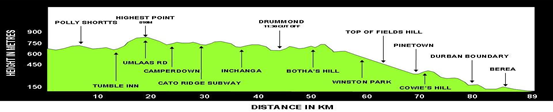
With only a few days left until race day, I hope you have had a look at the route profile by now. 

Just in case you haven't seen it or maybe chosen to forget it, here is a little reminder:
The official profile as provided by CMA:


And one with a bit less smoothing:


Yes, the organisers call it a 'down run'. They tend to do this every second year. Has nobody told them it is just as tough, and that there are still a few uphills along the way??

Being prepared for race day takes a lot more than just the miles of training (which, I assume, you have already done). You need to be physically fit while at the same time being well rested. You need to be mentally prepared. And you need to be covered in sun screen.

I trust you are all well prepared physically, and going into taper mode now to get the legs well rested before race day. Now you need to get mentally prepared. We'll pack the sun screen later.

27 days to go. You will be hearing lots of Comrades talk now and war stories will abound when you are out on the road with your fellow runners. Listen to all of them, but choose carefully what you want to hear. Don't get scared off. Just garner up some respect for the road that lies ahead.

The first thing you need to understand is how far it is. 89.28km. This is the official distance of the 2014 race as announced by CMA today. But that is for the A-seeded elite runners who get to stand on the start line. Anyone standing back in lower seeding groups can add a few metres to that. Still gonna be shy of the 90km that everyone has been talking about, so not that bad anyway!

The Comrades route is comparable to an enormous elephant. And despite common belief, there are actually 2 ways to eat an elephant:


  • "One bite at a time" - this is the most talked about method.

    1. "Invite some friends to help you" - quite obvious, but often missed method.
    Yes, you need to take the route one step at a time. One hill. One landmark. But if you find some buddies to do it with you, it is guaranteed to be a much more enjoyable experience! (You will still have feelings of over-indulgence at the end. There is more than enough elephant for everyone). Finding someone along the route to spend some time with certainly helps pass the time, and kilometres. The life of a distance runner is lonely, but with a few thousand people on the same road, there is no need for that. There will always be someone around or near you that will be keen to chat and cheer you up. There will always be someone around you that is feeling better than you. And there will always be someone around you that is having a worse day than you. Find a buddy and help them along, and that in turn will help you.

    Another part of the Comrades campaign that I am sure you have heard about is what they call "the Big Five":

    • Polly Shortts
    • Inchanga
    • Botha's Hill
    • Fields Hill
    • Cowies Hill
    A nice African ring to it. "Big Five". Marketing. Crap. Get over it.


    Then CMA refers to other 'landmarks' such as Ashburton, 45th Cutting, and Tollgate. So the organisers have admitted there are some hills on the 'down' run. Real buggers too. But they only earn the classification of 'landmarks'. And then there are some that are longer and steeper than Heartbreak Hill on the Boston Marathon route. But they are not quite big enough to earn names on the Comrades route. So the are generally not spoken about.

    Well, over the next few days I will send out a number of emails with detailed route descriptions and explaining the route in 'bite sized chunks' to try help prepare your mind for what lies ahead. I'll try include some of the unnamed hills too.

    Spend some time looking at the route profile. Let it scare you now. You have 27 days to get over it.


    And remember - distance running is 90% mental, and the other half is physical.


    Stay healthy!

    Cheers,
    Andrew


    Part 1

    Monday, 28 April 2014

    2014 Comrades Marathon Countdown Pt 5


    Comrades profile - is it really that tough??


    We all get quite scared when looking at the Comrades route profile. The standard route profile, as published on any website, looks like this:


    I'm sure you are familiar with it. And yes, it looks quite daunting. Big rising hills, punishing down hills, and a long long way.


    But it could look a lot worse:

    Or, a lot easier:


    It really is all just in the mind.

    Remember, this is the same route that has been completed by runners (and vehicles) since 1921. It can be conquered. And you are destined to do it!

    Stay focused, stay healthy and start taking it easy. You need to be in good shape on 1 June 2014.

    Cheers,
    Andrew

    Monday, 21 April 2014

    2014 Comrades Marathon Countdown Pt 4

    Why do we sleep so well at night??

    I absolutely loved this bit of useless research that I dug up around this time last year. Check this out:


    Why do we sleep so well at night?? Is it because we are running so much, we are tired and need the rest??

    I found some research of one Seth Roberts that is worth sharing, and bending to suit our excuses... (and bearing in mind you can not believe everything the Americans say...)

    Seth Roberts (http://en.wikipedia.org/wiki/Seth_Roberts) was known for turning his personal problems into research topics, and testing various theories on himself. Of course, this is not the best or well recognised way of performing research. There is no control group, and there is no possibility for a blind test, let alone a double-blind, as the test subject and researcher are one and the same. None the less, he is a professor of psychology - which means he can at least convince other people that he understands them better than they understand themselves. Personally, I don't understand that...

    He suffered from insomnia, and found he would wake up after just a few hours of sleep, and not be able to sleep again. This led to him suffering from afternoon fatigue, and not being able to be fully productive during the day. (I reckon he was over training!!)

    After trying various scenarios, he found the following best worked for him to solve his insomnia issues and get good sleep at night:
    • He made sure he got lots of morning light every day
    • He skipped breakfast, and ate only 2-3 hours after first waking
    • To lift his mood, he watched at least one hour of TV each morning - specifically full-faced TV such as talk shows, news, interviews, etc that would show people's faces in near life-size. But he never watched TV at night.
    • He spent at least 8 hours a day on his feet - either standing or walking. This would include time at his work, walking between work stations, etc.
    After finding the above worked so well for him, he researched back into history and found that under the Stone Age, early humans had lots of face-to-face interaction early in the mornings but not after dark, were active early in the day carrying out daily chores, and without desk jobs or PC's obviously spent a lot more time on their feet than sitting or slouching about!

    So why do we sleep well??
    • Lots of early morning light as we head out for those runs...
    • Eating a good meal only after we return home after the run - eating at least 2 hours after waking...
    • Face-to-face interaction with fellow runners early in the day...
    • A few extra hours on your feet as you pound the pavements...
    Fits perfectly into his research, all makes sense to me!!

    Imagine Comrades:
    • Up to see first light, and the whole morning, and probably the best part of the afternoon...
    • Eating a good meal only after you finish - definitely more than 2-3 hours after waking...
    • Face-to-face interaction with 14,000 other individuals - all day...
    • A good 8 hours on your legs - if you are fast. Otherwise even more...
    So that's why we sleep so well after Comrades!!! And sometimes for two days!!!

    Have a great day, and a good night's sleep!!!

    Cheers,
    Andrew

    Part 1


    Monday, 14 April 2014

    2014 Comrades Marathon Countdown Pt 3

    Rest!

    I know, we all speak about mileage and putting in the distance. But rest is just as critical to the training program as is the long run.

    With all the increased mileage, our bodies are weakened and might demand some rest in order to recover properly. Being focused on Comrades and trying to put in high mileage, we may fall into the trap of 'over training'.

    This term is always bandied around by runners, and we sometimes think it is impossible to over train our bodies. Which is of course true. Our bodies are complex machines, and in order to save itself, it will shut down and stop before you can cause any serious damage to it. So no worry there. The worry of course comes when it does shut down and we lose a few training days. Not cool.

    Fortunately, our body offers warning signs before shutting down. Our bodies were clearly not designed by Microsoft! These signs of over training are varied, and here's a list and explanation of what to look out for:

    • Over training is the result of working and exerting too hard, to a level more than the body can handle. Training causes the body to break down, and recovery allows the body to rebuild. This constant break down and rebuilding is what makes us stronger as we train. The intelligent body rebuilds to a level higher than it was. However, when the break down exceeds the recovery and build up, and the ability to recover is outpaced by repetitive and continued high intensity training, this leads to decreased performance. 
    • Over training leads to a suppressed immune system. Illness, colds and flu that seem impossible to shake off is often the result.
    • Extreme weight loss - caused by the body battling to rebuild what we have broken down. Training hard will cause weight loss, but a sudden drop in body weight could be a sign of over doing it. If the body is unable to restore at the same rate of breakdown, you need to replenish more (higher intake, supplements, etc) or reduce the burn.
    • Tired and fatigued - Taking a nap is at the top of your list of things to do. Your body is demanding rest, and forcing you to give it. Now!
    • Poor concentration - finding yourself unable to concentrate in the office is a possible sign of over training, or of you hating your day job. Inability to concentrate on your favourite TV series or sports match is a sure sign the body (and mind) are tired and demanding more rest than what you are giving it.
    • Restless sleep - as tired as you feel, you find you can't sleep well at night, or wake during the night and can not go back to sleep. This is caused by the body, mind and nervous system being over stimulated and unable to turn off. This can not be fixed with rest, but only with reduced exertion.
    • Increased heart rate - a resting pulse, measured on waking, is a good indication of fatigue. An increase of 5 beats per minute is a clear indication that the body has not recovered from the previous workout and needs more rest. Of course, this test only works if you don't wake with a noisy alarm clock! If you train with a heart monitor, you might also notice an increased heart rate at your normal training intensity. This should be ringing alarm bells.
    • Slow recovery from long or hard training sessions - if you seem to take longer to recover and get back on the road following a tough run, your body has not recovered and is demanding more rest.
    • Loss of enthusiasm - Finding yourself going into a state of depression over life in general, and especially about running, is a sure sign that you have over done it.
    • Impaired racing times - best measured on the club time trial course, or one of your standard training routes. If your times are getting slower or you find it increasingly difficult to run at the same pace, you need to take a break. Feeling heavy on the training runs, like you have weights tied around your ankles, is a sign you need some rest.
    • Constant aches and pains - If you're constantly fending off niggles, it could be a sign that you are on the brink of a much bigger injury.
    • Irritable and grumpy - something a loving spouse would allude to. This is caused by our over stimulation of the sympathetic nervous system through heavy training. The stress caused by heavy training, lack of sleep, nutritional deficits coupled with normal work and family stresses leaving you unable to rest, fully relax and perform at your best. Lack of relaxation, leaving you constantly hyped, leads to grumpiness. Deal with it. Take a break, before your spouse tells you to.
    • Lost libido - Tired and fatigued, the rest of the body is unable to perform too. The need to go to bed early to get some rest, followed by an early start to the day with yet another long run will definitely have an impact on a relationship. If the non-running spouse is getting irritable and grumpy too, take note and take a day off from the regular training, and get some other stretches in.
    To recover from over training, all you need to do is restore the body's balance between build up and break down. Depending on how far into over training you have progressed, simply reducing the intensity of your workouts (without reducing mileage) may be sufficient. How long it takes to recover, depends on how deep a hole you might have dug. 

    Reducing intensity and mileage for a day or two might provide the fix, or it could mean taking a whole week off. Also, watch your diet - you may need to increase carbs, proteins and sugars to feed the body's energy stores during the high intensity training. Hydration is also critical - make sure you drink plenty water. Lastly, try give your body an extra hour sleep at night.


    If you are feeling tired, hungry and thirsty then you probably are tired, hungry and thirsty. Give your body what it needs!


    Rest and allowing the body to rebuild, is critical to any training program. Make sure you replenish your body through food intake, supplements, and rest during these critical weeks of race build up. You don't want to be standing on the start line on 3rd June feeling tired, grumpy, sore and heavy. You really want to be feeling fresh. The heavy demands of Comrades training will certainly take its toll on your body,  but be careful not to over do it, and make sure you will be fresh on race day.


    Happy training!


    Cheers,
    Andrew


    PS - Symptoms of over training and symptoms of sheer laziness are very similar. Don't get confused or use over training as an excuse.

    Part 1
    Part 2

    Monday, 7 April 2014

    2014 Comrades Marathon Countdown Pt 2

    Comrades is coming...

    Yes, just in case it might have slipped your mind, in only 55 days time, you should have a very small medal hanging around your neck.

    With some long runs behind us, and all trying to put in some extra mileage during the week, I am sure everyone is feeling tired, and maybe even gatvol for running. Hang in there. The next few weeks are critical. You have to keep going, even though the mornings are a little colder and darker than they have been, and running in the evenings might be chilly too. Don't stress (the term 'don't sweat' wouldn't quite work here) and don't use the weather as an excuse either. There is great gear out there to keep you warm while training for what you really want.

    A few pointers when running, especially in the dark:

    • Wear reflective vests or reflective clothing
    • Wear light coloured clothing (why races hand out black T-shirts is beyond me...)
    • Use a head torch if necessary. It makes you more visible to other road users, and may also show up the potholes and cats eyes that you would otherwise fall over.
    • Don't run with an MP3 player or ipod. Not being able to hear the traffic around you is dangerous. And especially when it is still dark.
    • Don't run using a walkman either - it is extremely old fashioned!
    • Run on the right hand side of the road, facing on coming traffic. At least you can see if some driver has not seen you.
    • Listen out for overtaking vehicles behind you.
    • Make the assumption that you are invisible to other road users, and every other road user is an idiot.
    Running in the cooler weather is also risky when it comes to muscle strains and the likes. Be careful that you don't start your run too fast. Muscles are tight in cold weather, and going too hard or attacking the hills could easily lead to muscle injury. Use the first few km to warm up, and do your speed work later in your run once you are properly loose. You shouldn't be doing too much racing any more anyway.

    Another 2 weeks until we enter the '6 week window' of tapering before race day. I am sure everyone is looking forward to the taper!


    Enjoy your running, keep warm, and stay visible.


    Cheers,
    Andrew


    Part 1

    Tuesday, 14 May 2013

    CC Comrades Corner - Andrew Dollenberg

    Boring, but important Comrades details

    Since you are now tapering, and have so much available time on your hands, why not look at the route, maps and finer planning details?

    Here is a map of the finish area for the 2013 Comrades Marathon.

    For those that have run the 'up' before, take note of the slight changes as you approach The Oval. Most importantly, take note of the warning for speed bumps in the 'last mile' going down Princess Margaret Drive. The last thing you want to do at this stage is trip and fall. 


    Click on image to enlarge.
    I've also attached a map of the Comrades route (thanks Chrisjan for this) which can be downloaded here. It is quite large, so don't try to print it unless you own a large scale plotter. To view it online, go to http://www.mapmyrun.com/routes/fullscreen/30731118/You may find this useful in studying the route, and also for your supporters to figure out the best place to meet you along the side of the road. 

    And if you want to make it a little easier for your family and supporters, pass them this detail so they can figure out access and parking in order to meet you on time and in a good mood, whether along the route or at the finish.

    Lastly, and for the techno junkies that love this kind of stuff, here (go to file, download) is also a Googlemap .kmz file that you can check out on Google Earth. It shows the full details of the route, refreshment stations, physio stations, key landmarks, and anything else you might be able to see from a satellite 520km above earth. 

    Keep well, keep healthy and take it easy now.

    Regards,
    Andrew.